Symptoms of Failing Diesel Turbo You Should Not Ignore

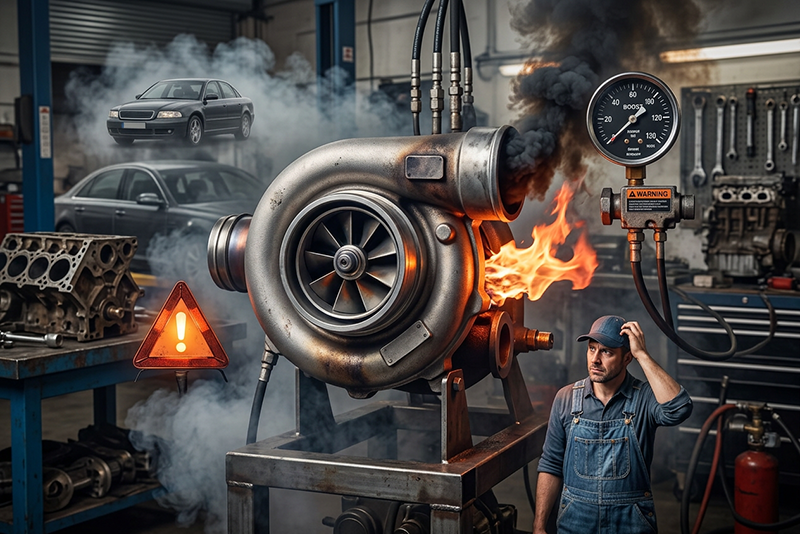
A diesel truck that suddenly feels flat under load is not always dealing with a fuel problem. When boost drops off, the engine may still idle cleanly and run well enough to get around town, but it will struggle when the trailer is hooked up, the grade gets steep, or the workday gets long. Knowing the symptoms of a failing diesel turbo can help you stop a minor air-system issue before it damages the turbocharger, contaminates the intake, or creates a much larger engine repair.
A turbocharger operates at extremely high shaft speeds and depends on clean oil, unrestricted airflow, proper exhaust flow, and a healthy control system. One failed hose clamp can imitate a bad turbo. On the other hand, continuing to run a turbo with bearing damage can send oil into the charge-air system and create a serious risk to the engine. The right move is to inspect the whole system before ordering parts.
Symptoms of a Failing Diesel Turbo
Loss of power under acceleration or load
The most common complaint is reduced pulling power. The truck may feel lazy leaving a stop, take longer to build speed, or downshift more often on hills. On a working truck, the difference is usually obvious when carrying weight. A diesel engine can run without normal boost, but it will not make the torque it was designed to produce.
Do not assume every low-power condition means the turbo itself has failed. Split charge-air cooler boots, leaking intercoolers, loose clamps, cracked intake ducts, stuck variable-geometry turbo vanes, exhaust leaks, and faulty boost sensors can all reduce boost. Start by checking actual boost pressure with a scan tool or mechanical gauge and compare it with the commanded boost when applicable.
Whining, siren noise, or unusual turbo sound
A healthy turbo makes a controlled whistle as it spools. A high-pitched siren sound, a dentist-drill whine, scraping noise, or a sudden change in the normal whistle deserves attention. These sounds can point to worn shaft bearings, a compressor wheel contacting the housing, foreign-object damage, or a boost leak that is forcing air through a damaged connection.
Noise alone is not enough to condemn a turbocharger. A leaking exhaust manifold gasket can create a whistle, while a charge-air leak may produce a noticeable hiss under throttle. Inspect the exhaust side for black soot trails and pressure-test the charge-air system before replacing major components.
Excessive exhaust smoke
Smoke color matters. Black smoke often means the engine has fuel available but not enough air to burn it efficiently. Low boost, restricted intake flow, a stuck VGT mechanism, or a charge-air leak can all contribute. You may see black smoke during acceleration along with poor fuel economy and reduced power.
Blue or blue-gray smoke is more serious because it can indicate engine oil entering the intake or exhaust. A turbo with worn bearing seals may pass oil, but oil smoke can also come from engine wear, crankcase ventilation problems, or excessive blow-by. White smoke is less specific and may be related to incomplete combustion, injector issues, coolant intrusion, or cold operation. Diagnose the source instead of using smoke color as the only test.
Rising oil consumption or oil in the charge-air system
A light oil film inside intake piping is normal on many diesel engines, especially where the crankcase ventilation system routes vapor back into the intake. Pooled oil, dripping connections, or a charge-air cooler holding a significant amount of oil is not normal. It requires immediate inspection.
Check the turbo inlet and outlet piping, compressor housing, intercooler tubes, and charge-air cooler. If oil is present, determine whether it came from the turbocharger or from excessive crankcase pressure. A blocked crankcase breather or heavy engine blow-by can push oil through the intake and make a good turbo look bad.
If a diesel begins consuming oil rapidly or starts running uncontrollably on engine oil, shut it down safely if possible and do not continue driving it. A diesel runaway is an emergency. The engine can accelerate beyond governed RPM and suffer catastrophic damage.
Check engine light and boost-related fault codes
Modern diesel engines monitor boost pressure, exhaust pressure, turbo vane position, actuator operation, and air temperature. A check engine light with underboost, overboost, turbo actuator, or vane-position codes should be taken seriously. Common complaints include intermittent limp mode, reduced-power warnings, and a truck that clears up after cycling the key only to return under load.
An electronic actuator failure can mimic a failed turbocharger, particularly on variable-geometry units used on Cummins, Ford Power Stroke, Duramax, Detroit, Paccar, and other late-model platforms. Wiring damage, connector corrosion, calibration issues, soot buildup, or a sticking unison ring may be the real problem. Scan data and actuator testing can prevent an expensive misdiagnosis.
Oil leaks, damaged blades, or shaft movement
A visual inspection can reveal a lot. With the engine off and the intake tube removed, inspect the compressor wheel for chipped, bent, or rubbed blades. Look for signs that the wheel has contacted the housing. Check for foreign material that may have entered through a damaged air filter, loose intake duct, or failed compressor-side component.
You can carefully check shaft movement, but understand what you are looking at. A small amount of side-to-side movement may be normal on an oil-film bearing turbo when it is not pressurized with oil. The blades should not touch the housing, and in-and-out movement should be minimal. Excessive axial play, housing contact, or a wheel that does not rotate freely are strong signs that the turbocharger needs replacement or professional evaluation.
What Causes Diesel Turbos to Fail?
Turbochargers rarely fail without a reason. Installing a replacement without correcting the cause can destroy the new unit just as quickly. The most common causes are oil starvation, contaminated oil, restricted oil drain lines, intake restrictions, foreign-object damage, exhaust leaks, overspeed, and control-system faults.
Oil is especially critical. A restricted oil feed line, sludge in the oil passage, incorrect gasket installation, or delayed priming after installation can damage the center section within minutes. On the drain side, a kinked, coked, or poorly routed return line can prevent oil from leaving the turbo. The result is oil leakage past the seals and bearing damage.
Variable-geometry turbos add another layer of diagnosis. Soot and heat can cause vane mechanisms to stick, while a failed electronic actuator may keep the vanes in the wrong position. That can create low boost, high drive pressure, overboost conditions, and fault codes even when the rotating assembly is still serviceable.
How to Confirm the Problem Before Replacing the Turbo
A proper diagnosis starts with the basics: inspect the air filter, intake tract, exhaust connections, charge-air piping, intercooler, and clamps. Pressure-test the charge-air cooler system because a small split in a boot can open only under boost. Look for oil residue around connections, but remember that residue shows where air has been escaping, not necessarily where the original failure began.
Next, verify oil supply and drainage. Check engine oil level and condition, confirm the correct oil specification, and inspect the turbo feed and drain lines for restrictions or damage. Use scan data to compare desired boost with actual boost, then review turbo actuator position, exhaust backpressure, and related sensor readings where the platform supports it.
For a VGT-equipped truck, do not skip actuator and vane testing. Replacing the complete turbo when only the actuator has failed can add unnecessary cost. Conversely, installing an actuator on a turbo with seized vanes or excessive shaft play will not fix the truck. The best repair is based on measured evidence, not a guess from one symptom.
What to Replace With a Failed Turbocharger
When the turbo is confirmed bad, replace more than the obvious failed part when the condition calls for it. Oil-contaminated intercoolers and charge-air pipes must be cleaned or replaced. Damaged intake components, restricted oil lines, failed air filters, leaking exhaust gaskets, and defective actuator-related components need correction before the new unit is installed.
For commercial trucks and hard-working pickups, part quality matters. A remanufactured turbocharger should be built with properly inspected components and tested for performance, not simply cleaned and reassembled. Match the turbo to the exact engine arrangement, emissions configuration, actuator type, and original part number whenever possible. Small differences in calibration or fitment can create major driveability problems.
American Diesel Parts supplies remanufactured, rebuilt, OEM, and premium replacement turbochargers for major diesel applications, with knowledgeable support for shops, fleets, and truck owners who need the correct repair the first time.
Do not wait for a low-boost complaint to become oil consumption, a damaged charge-air system, or an engine-out event. If the truck has lost power, changed its normal turbo sound, started smoking, or set boost-related codes, park the guesswork and inspect the complete air, oil, exhaust, and control systems before the next loaded run.